
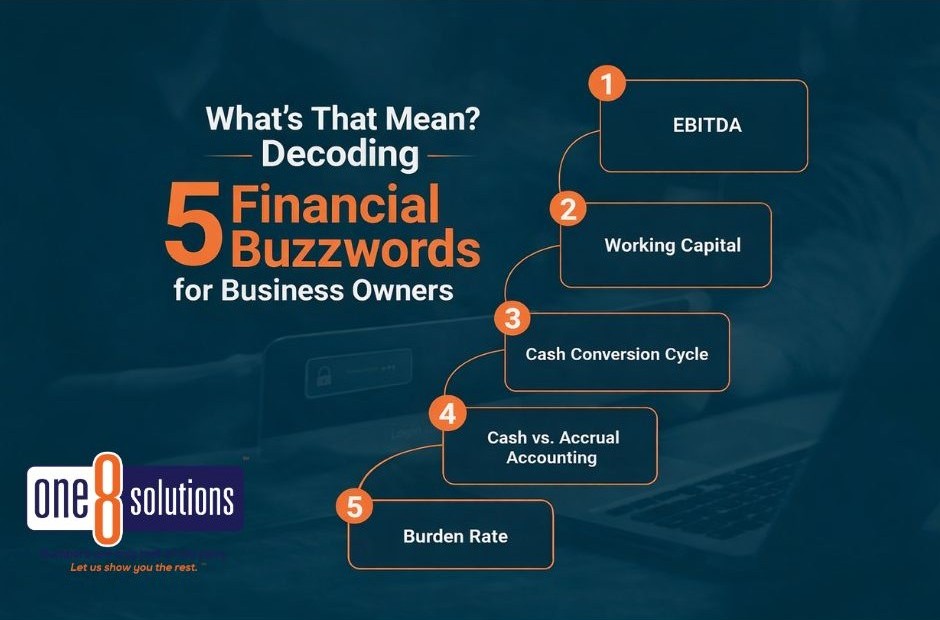
 What’s That Mean? Decoding 5 Financial Buzzwords for Business Owners
Have you ever been in a meeting with your accountant and heard terms like EBITDA, working capital, or cash conversion cycle and wondered what those numbers actually mean for your business?
You are not alone. Finance buzzwords can sound like a different language. Yet these terms are not just technical jargon. They explain how money moves through your company and whether the business model is working.
Understanding a few key financial concepts makes conversations with your accounting team more productive. And it helps you make better decisions about hiring, pricing, and growth.
Below are several financial buzzwords business owners hear often, explained in plain English.
Quick Definitions Business Owners Should Know
Before diving deeper, here are simple explanations of several financial terms that often come up in conversations with accountants and advisors.
- EBITDA
A measure of how profitable a business is from its core operations before interest, taxes, depreciation, and amortization. - Working Capital
The difference between current assets and current liabilities. It indicates whether a business can cover short-term obligations. - Cash Conversion Cycle
The amount of time it takes for money spent on operations or inventory to return as collected cash. - Cash vs. Accrual Accounting
Two different ways to record income and expenses. Cash accounting records transactions when money changes hands, while accrual accounting records them when they are earned or incurred. - Burden Rate
The true cost of employing someone after payroll taxes, benefits, and other employment-related costs are included.
These concepts appear frequently in financial reports, planning conversations, and lending discussions. Understanding them makes it easier to interpret your numbers and make stronger business decisions.
EBITDA: A Clear Look at Your Core Profit
Think of EBITDA as the operating engine of your company.
A recent article titled “Understanding EBITDA” published by Financial Poise states that EBITDA stands for earnings before interest, taxes, depreciation, and amortization. “EBITDA helps isolate operational profitability by removing financing and accounting variables.”
Business owners often hear the term EBITDA when discussing profitability or business valuation. It measures how profitable your business is from its core operations before financing costs and accounting adjustments are included.
In simple terms, EBITDA answers this question: How profitable is the business before loan payments, tax strategy, and asset depreciation are factored in?
Example
A consulting firm generates $1.5 million in revenue. After covering staff, software, rent, and other operating expenses, $350,000 remains as operating profit. That amount represents its EBITDA.
But the owner may also pay:
- interest on a loan
- depreciation on equipment
- corporate taxes
EBITDA excludes these factors to show how well core business operations are performing.
Why EBITDA matters for business owners
- Investors and lenders often review EBITDA when evaluating performance or valuing a business
- It helps compare profitability across companies
- It shows whether core business operations are profitable
For business owners, EBITDA answers a simple question: Is the business itself profitable before financing decisions or tax strategy enter the picture?
Working Capital: Your Short-Term Financial Cushion
Working capital measures whether your business has enough short-term assets to cover short-term obligations.
The formula is straightforward:
Current Assets – Current Liabilities = Working Capital
Current assets include cash, receivables, and inventory. Current liabilities include bills, payroll obligations, and short-term loans.
Positive working capital means the business can comfortably cover its short-term obligations. Negative working capital signals potential pressure on cash flow.
Example
A construction company has:
- $200,000 in receivables
- $50,000 in cash
- $170,000 in short-term obligations
This results in $80,000 in working capital.
Understanding working capital helps business owners plan hiring, equipment purchases, and vendor payments with greater confidence. It determines whether the company can operate smoothly without cash shortages.
Many profitable businesses struggle because they run short on working capital. For more on how financial visibility supports stronger planning, see our article titled
“From Bookkeeper to Business Advisor: Why Strategic Advisory Is the New Value Driver.”
Financial terms like these are not just accounting language. They explain how money moves through your business. When owners understand these metrics, financial reports become tools for decision making rather than documents to review at month end.

Cash Conversion Cycle: How Long It Takes Sales to Turn Into Cash
The cash conversion cycle measures how long it takes for money invested in operations to return as collected cash.
It combines three timeframes:
- how long inventory sits before being sold
- how quickly customers pay invoices
- how long you take to pay vendors
A shorter cycle means cash returns to the business more quickly.
Example
A manufacturing company:
- holds inventory for 45 days
- collects invoices in 30 days
- pays vendors in 40 days
This results in a 35-day cash conversion cycle.
Each dollar invested in production takes about five weeks to return as cash.
Tracking this number helps owners identify operational issues such as slow collections or excess inventory. A shorter cash conversion cycle also makes it easier to manage growth without relying heavily on borrowing.
Accrual vs. Cash Accounting: When Revenue Actually Counts
Many business owners are surprised to learn there are two primary ways to track income and expenses.
Cash accounting records revenue when money arrives and expenses when money leaves.
Accrual accounting records transactions when they are earned or incurred, even if cash has not yet changed hands.
Example
A marketing agency completes a $20,000 project in March but receives payment in April.
- Cash accounting records revenue in April
- Accrual accounting records revenue in March
Accrual accounting often provides a clearer picture of business performance because it matches revenue with the expenses required to generate it.
In our article titled “Financial Strategy Planning: How to Start the Year With a Clear Financial Roadmap,” it is noted that “accurate financial reporting allows business owners to make decisions based on reality rather than assumptions.”
Overhead vs. Burden Rate: Understanding the True Cost of Labor
Another pair of terms that often causes confusion is overhead and burden rate.
Overhead includes general business expenses required to run the company that are not directly tied to producing a product or service.
Examples include:
- office rent
- administrative salaries
- insurance
- software subscriptions
The burden rate measures the total cost of employing someone beyond their base salary. This can include payroll taxes, health benefits, retirement contributions, workers compensation insurance, and other employment-related expenses.
Example
If an employee earns $80,000 per year and benefits and taxes add another $20,000, the total employment cost is $100,000.
Understanding the burden rate helps business owners price services accurately and protect profit margins.

Financial Terms Matter for Your Business Decisions
Financial buzzwords are not just accounting language. They are tools that help owners understand how their business is performing.
When you understand terms like working capital or cash conversion cycle, conversations with your accounting team become more productive.
You can ask better questions such as:
- Why are receivables increasing?
- How fast is inventory moving?
- Are margins improving as revenue grows?
Clean books are the foundation. The real value comes from understanding what the numbers mean.
When financial information is explained in plain language, reports become far more valuable. They become a roadmap for your next decision.
How One 8 Solutions Helps Translate the Numbers
Business owners do not need to memorize accounting terminology. What matters is having a team that translates the numbers into clear guidance.
At One 8 Solutions, we serve as an outsourced accounting department partner for growing businesses. Our team manages bookkeeping, controller-level accounting, and financial analysis so owners can understand their financial position and make confident decisions.
If you want to understand what your numbers are telling you, schedule a complimentary Zoom conversation with our team.
